Paul Cézanne.
Post-Impressionist founder of structural color and modernist composition — the painter who taught later generations that the picture is a constructed object, not a window.
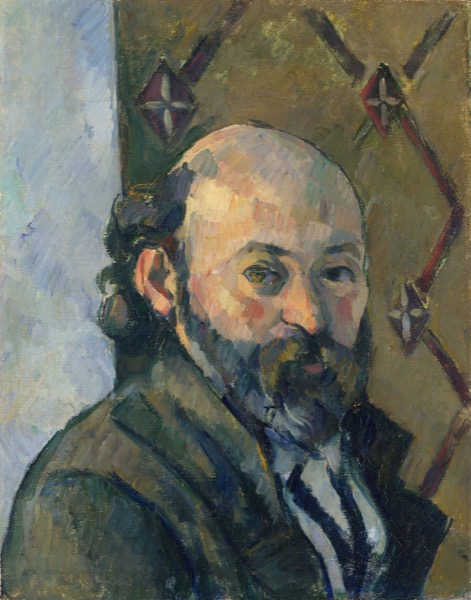
Paul Cézanne (1839–1906) was a French Post-Impressionist whose work bridges 19th-century Impressionism and the foundational moves of 20th-century modernism. He worked primarily in still life (apples, oranges, kitchen objects), landscape (above all Mont Sainte-Victoire, painted dozens of times across his late career), and figure (The Card Players, The Large Bathers). His technical signature is the constructive brushstroke — small directional strokes of color that build form through plane changes rather than through traditional value modeling. His compositions are rigorously geometric, often using subtle distortions of perspective that emphasize the painting as a designed object rather than as an illusion of space. He was admired and studied by Picasso, Braque, and the Cubists; Matisse called him "the father of us all."
Cézanne exemplifies three principles: structural color (building form through color planes rather than value modeling), compositional rigor (the painting as a constructed object), and the discipline of repeated observation. His structural color is the principle most often associated with him. Rather than modeling a form through gradations of value, Cézanne builds the form through small adjacent planes of color, each plane a slightly different temperature or chroma. An apple in a Cézanne still life is not rendered as a smooth sphere with light and shadow; it is constructed of warm planes, cool planes, neutral planes, each placed where the form turns. The result is a form that reads as three-dimensional without using the traditional value gradient. This was a radical move at the time and a foundational influence on Cubism: if form can be built of planes of color, then the painter can fragment the planes further, multiply viewpoints, and the painting will still hold. His compositional rigor is the second principle. Cézanne's still lifes look casually arranged but are not. The placement of every apple, the tilt of the tabletop (often subtly distorted to reveal more of the objects than perspective would strictly allow), the shape of the negative spaces between objects — all are designed. His landscapes use the same rigor: Mont Sainte-Victoire is painted not as it is but as the composition requires. Painters studying Cézanne learn that the painting is a constructed object that obeys its own internal logic, not a copy of the world. His discipline of repeated observation is the third principle. Like Monet, Cézanne painted the same subjects repeatedly across decades. Mont Sainte-Victoire was painted dozens of times — different times of day, different seasons, different distances. The repetition allowed Cézanne to abstract progressively further, to push the structural color and compositional logic further with each iteration. The late Mont Sainte-Victoire paintings approach geometric abstraction while remaining recognizable as the mountain. The discipline of returning to the same subject is what made the progression possible. What Cézanne does not exemplify, by contrast, is alla prima freshness (he often took years on a single painting, with extended series of sittings), or traditional value-based modeling, or seductive painterly surface. His work can look stiff or awkward to viewers expecting Sargent or Sorolla; his lesson is different. The Cézanne painter is making constructed pictorial objects, not capturing optical moments. The accessibility of Cézanne depends on the viewer's painting experience. To a beginner, Cézanne's apples look poorly painted compared to academic still lifes. To a painter who has worked through value, color, and composition seriously, Cézanne's apples are extraordinary — every plane is considered, every shape is designed, every color is placed in relation to its neighbors. The depth is in the construction, not the surface.
- Mont Sainte-Victoire series (1880s–1906) — the late landscape obsession; structural color at its most developed. - The Card Players series (1890–95) — figure composition; the geometric armature. - Still Life with Apples (multiple, 1890s) — the apples; the constructed tabletop. - The Large Bathers (1900–06) — late figure composition; the geometric simplification. - Boy in a Red Vest (multiple versions, 1888–90) — figure portraiture; color as structure. - The Bay of Marseille seen from L'Estaque (c. 1885) — landscape construction; structural color in landscape mode.
The most useful Cézanne copy is a single still-life passage — typically a section of apples on a tabletop. Don't try to render the apple as a sphere with light and shadow; instead, copy the planes of color exactly as Cézanne placed them. Note where the warm planes are, where the cool planes are, and how the form turns through plane changes rather than through value gradient. A second exercise is to compose your own still life and arrange it on a tilted tabletop, then deliberately distort the perspective subtly to reveal more of the objects than strict perspective would allow. This will teach the Cézanne move of subordinating accuracy to design. A third exercise is to study Mont Sainte-Victoire across its many versions. Note what stays the same (the mountain's silhouette, the broad compositional structure) and what changes (the color, the level of abstraction, the relationship of foreground to mountain).
- Treating his work as poorly drawn or unskilled when it is in fact rigorously constructed. - Imitating the surface look (the small directional strokes) without understanding the structural logic underneath. - Studying single works rather than series; the discipline is across the series. - Trying to apply Cézanne's logic to subjects that don't suit it (e.g., quick plein air); his discipline is the patient construction, not the rapid impression. - Treating him as the founder of modernism in a vague sense rather than as a specific painter with specific technical lessons. - Ignoring his color: the structural color is the lesson, not just the geometric composition.
Cézanne worked in the wake of Impressionism, in dialogue with Pissarro (who was an early mentor) and the Impressionist circle. He worked in relative isolation in Provence for much of his late career, painting Mont Sainte-Victoire and the surrounding landscape with progressive abstraction. After his death, the Cézanne retrospective in 1907 was a foundational event for Cubism — Picasso and Braque saw structural color and pictorial construction as opening doors that they would walk through. His influence runs through Cubism, Fauvism, modernist composition, and into the entire 20th-century tradition of the painting-as-constructed-object.
Color
The properties of hue, chroma, and temperature, plus the relationships between them — the second most powerful tool in painting after value, and the trickiest of the foundational principles to teach.
Composition
The arrangement of shapes and the design of the picture plane — the structure on which everything else hangs. Successful composition leads the eye in, holds it at the focal point, and prevents it from escaping the frame.
Simplification
The skill of reducing visual information to its essential design — knowing what to leave out is often more important than knowing what to put in.
↳ image rights status: public domain