Richard Diebenkorn.
American mid-century master of composition and edge in abstraction — the painter whose Ocean Park series shows what color, edge, and structure can do without representational subject.
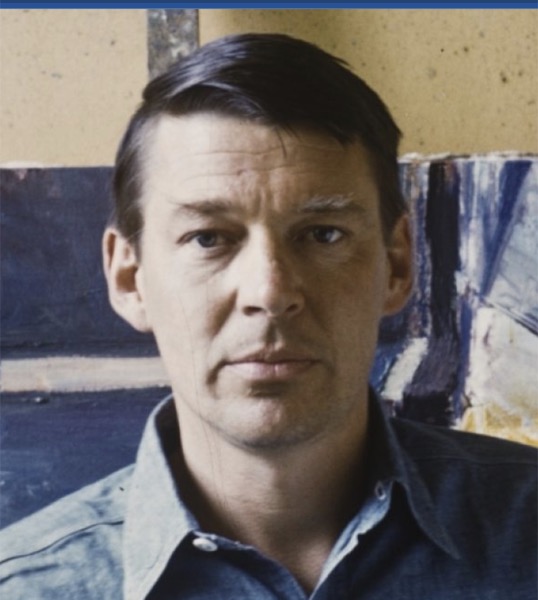
Richard Diebenkorn (1922–1993) was an American painter who worked through three distinct phases: early Abstract Expressionism (1940s–50s), figurative work in the Bay Area Figurative Movement (mid-1950s through 1960s), and a return to abstraction in the Ocean Park series (1967–1993). His technical signature is the composition as the primary subject of the painting: large rectangular fields of color, restrained palette, precise edges, and a visible record of decisions and reconsiderations across the painting's history. The Ocean Park paintings are some of the most rigorously composed abstract works in late-20th-century American painting, and they show that abstraction is not the abandonment of compositional discipline but its concentration.
Diebenkorn exemplifies three principles: compositional rigor in abstraction, color discipline, and the visible decision-making in the painting's surface. His compositional rigor is the principal lesson. The Ocean Park paintings are organized as carefully designed rectangles and trapezoids, with subtle adjustments in scale, weight, and proportion that determine whether each painting works. The compositions look casual at first glance — large fields of color with linear divisions — but on extended viewing the rigor becomes apparent. Every edge has been considered. Every proportion has been weighed. Every color choice serves the overall harmony of the composition. Painters studying composition can learn from Diebenkorn that the principles of design do not require representational subject — composition is composition whether the painting depicts a face, a landscape, or pure rectangles. His color discipline is the second principle. The Ocean Park palette is restrained: blues, ochres, pale greens, soft pinks, with occasional accents of strong color. The colors are mostly mid-chroma, often with chalky or grayed-down character. The relationships between colors do the work; saturation alone is not asked to carry the painting. This is color as Cézanne would have understood it: relational, restrained, in service of structure rather than for its own sake. Painters who think of color as primarily about saturation will learn from Diebenkorn that color decisions are about relationships, gamut control, and harmony. His visible decision-making is the third principle. Diebenkorn typically left earlier compositional decisions visible in the final painting — pentimenti (corrections that show through), erased and redrawn lines, areas where the color shifted late in the process. The painting carries the record of its own making. This is unusual: most painters cover their corrections. Diebenkorn deliberately let them show, treating the painting as a process whose history is part of its content. This invites the viewer to read the painting as a series of decisions rather than as a finished object. Painters can learn from this that the painting need not pretend to have arrived fully formed; the path matters. The Ocean Park series spans approximately 145 paintings, made between 1967 and 1988, all titled simply "Ocean Park" plus a sequential number. The series discipline — like Monet's series, like Cézanne's Mont Sainte-Victoire — is part of the lesson: returning to the same compositional problem allows progressive development. Diebenkorn's accessibility for representational painters is sometimes surprising. The compositional and color lessons from the Ocean Park series translate directly to representational work — many representational painters have cited Diebenkorn as a major influence on their handling of large-shape composition and color harmony.
- Ocean Park series (1967–1988) — the late abstract masterwork; ~145 paintings; the central body of work. - Berkeley series (early 1950s) — early abstract; landscape-derived. - Cityscape I (1963) — late Bay Area Figurative; representational composition. - Window (1957) — Bay Area Figurative; figure in interior; composition as primary subject. - Girl on a Terrace (1956) — figure painting; composition; color. - Studies and drawings (career-long) — the underlying observation; the discipline of seeing.
The most useful Diebenkorn copy is a section of an Ocean Park painting at small scale. Match the proportions of the rectangles exactly. Match the color relationships rather than the literal colors. Note where the edges are crisp and where they are soft; the variety is deliberate. A second exercise is to compose your own abstract painting using only large rectangular fields of color. Spend time on the proportions: how does shifting one edge by an inch change the overall composition? This will teach proportional sensitivity that is harder to develop in representational work. A third exercise is to do a representational painting (a landscape or interior) and analyze its underlying compositional structure as a Diebenkorn-like abstract pattern. Identify the major shapes, the proportions, the color masses. Strong representational paintings have strong abstract compositions underneath; Diebenkorn makes this visible.
- Treating his work as decorative or arbitrary; the compositional rigor is not obvious at first glance. - Imitating the surface look (rectangles of muted color) without absorbing the proportional sensitivity. - Studying only the Ocean Park abstracts and missing the Bay Area Figurative work; the figurative paintings show the same compositional discipline in different form. - Assuming abstract composition is easier than representational; the constraints are different, not lighter. - Ignoring the pentimenti and the visible decision-making; this is part of the work, not a flaw. - Treating him as a regional (West Coast) painter rather than as a major American modernist.
Diebenkorn worked in the American mid-century in dialogue with Abstract Expressionism (de Kooning, Rothko, Pollock) and the European modernist tradition (Matisse, Mondrian, the Cubists). He was associated with the Bay Area Figurative Movement (David Park, Elmer Bischoff) in the mid-1950s, then returned to abstraction in 1967. His Ocean Park series is one of the major American painting projects of the late 20th century. His influence runs into late-20th-century and contemporary representational painting through painters who learned compositional discipline from his work and applied it to representational subjects. Because his work remains under copyright, v1 should reference his paintings verbally and link to museum collections rather than embedding images.
Color
The properties of hue, chroma, and temperature, plus the relationships between them — the second most powerful tool in painting after value, and the trickiest of the foundational principles to teach.
Composition
The arrangement of shapes and the design of the picture plane — the structure on which everything else hangs. Successful composition leads the eye in, holds it at the focal point, and prevents it from escaping the frame.
Edges
The quality of the boundary between two shapes — hard, soft, lost, or found. Edge variety directs the eye and integrates form with ground. Edge control is what separates competent painting from masterful painting.
Simplification
The skill of reducing visual information to its essential design — knowing what to leave out is often more important than knowing what to put in.
↳ image rights status: under copyright