Winslow Homer.
American master of value, watercolor, and the figure or landscape under decisive weather — a painter whose best work captures American outdoor life with clarity and unsentimental honesty.
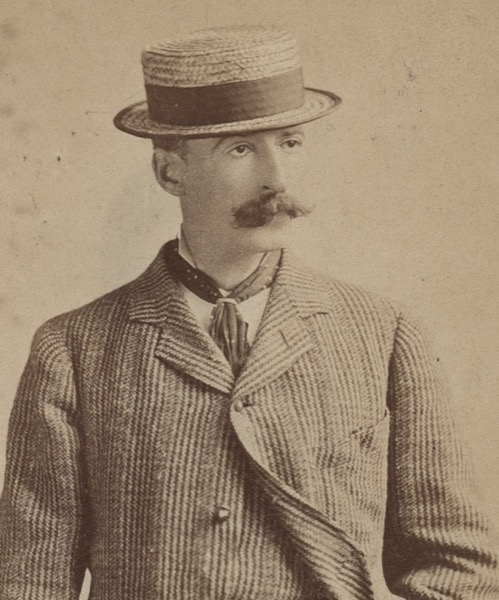
Winslow Homer (1836–1910) was an American painter whose career began as an illustrator (Harper's Weekly, Civil War subjects) and matured into one of the strongest representational painters America has produced. He worked in oil and watercolor (the watercolors are often considered his finest work), with subjects ranging from Civil War scenes, post-war rural American life, fishermen on the New England coast, Caribbean watercolors, and the late storm-and-survival paintings of the Maine coast. His technical signature is unsentimental value handling, direct observational drawing, decisive compositional design, and a unique mastery of watercolor as a serious medium for major work. He worked in relative isolation in Maine in his late career; his late watercolors are some of the most personal and technically free work in late-19th-century American painting.
Homer exemplifies three principles: unsentimental value handling, narrative composition, and watercolor mastery. His unsentimental value handling is the first principle. Homer's paintings of the Civil War, of rural American life, of fishermen in storms, are not sentimentalized. The values are honest: where the light is harsh, the shadows are harsh; where the figure is exhausted, the figure looks exhausted; where the situation is precarious, the painting does not soften it. This is uncommon. Much 19th-century narrative painting falls into sentimentality; Homer almost never does. The value structure carries this honesty: he paints what he sees without warming or softening it artificially. His narrative composition is the second principle. Homer's paintings tell stories — a fisherman returning at dusk, children playing in a field, a man on a small boat in heavy sea — without sliding into illustration. The composition serves the narrative but does not subordinate to it. The Gulf Stream (1899), one of his late masterworks, places a Black man alone on a damaged boat surrounded by sharks, with a distant ship visible on the horizon. The composition is rigorous; the narrative is implicit and unresolved; the painting carries the weight of the moment without becoming melodramatic. His watercolor mastery is the third principle, and the one most often singled out. Homer treated watercolor as a serious medium for finished work, not as preliminary study. His Caribbean watercolors and the late Maine watercolors are technically extraordinary: transparent washes layered with absolute control, white paper used as the lightest light, edges left soft or worked back with sponge or knife. American watercolor as a serious tradition runs through Homer to Sargent and into 20th-century watercolor practice. What Homer does not exemplify as strongly: portraiture (he did some but it isn't his strength), color sophistication (his palette is direct rather than nuanced), academic figure drawing (he was largely self-taught and his figures sometimes show it). His lessons are value, design, and watercolor. The American character of Homer's work is part of his lesson: he is unmistakably an American painter, working with American subjects, with a directness that is recognizably American rather than European. For American painters this is a useful reference point — there is a national tradition that does not require studying only European masters.
- The Gulf Stream (1899) — late oil masterwork; figure composition; narrative. - Snap the Whip (1872) — earlier rural American; children at play; composition and light. - Breezing Up (A Fair Wind) (1873–76) — figure composition; sailboat; outdoor light. - The Fog Warning (1885) — fisherman; New England coast; value and atmosphere. - Prouts Neck Maine watercolor series (1880s–90s) — coastal watercolors; the late watercolor mastery. - Bahamas watercolor series (1898–1901) — Caribbean watercolors; tropical light; transparent technique.
The most useful Homer copy is a watercolor — typically a small section from the Caribbean or Maine series. Match the transparency of the washes; resist the urge to thicken them. Use white paper for the lightest lights rather than white pigment. This will teach watercolor discipline that oil painting does not. A second exercise is to copy an oil painting like Breezing Up or The Gulf Stream as a value study, reducing it to three or four values. Note the design rigor underneath the apparent simplicity. A third exercise is to attempt your own narrative composition — a figure outdoors, a moment of weather, a small story — in the Homer manner: unsentimental, value-anchored, designed without flourish. The discipline is restraint and honest observation.
- Treating him as illustrative rather than as a serious painter; the surface directness can mislead. - Studying him for color when his lesson is value. - Ignoring the watercolors and focusing only on the oils; the watercolors are often where the technical lesson is most concentrated. - Imitating his subject matter (boats, fishermen, rural Americana) without absorbing the underlying value and design discipline. - Missing the unsentimental quality — adding emotional emphasis or atmospheric softness that Homer would not have. - Treating him as a regional or American painter who can be skipped in favor of European masters; he is a major painter on his own terms.
Homer worked in the American Realist tradition, contemporary with Thomas Eakins (also American Realist, more academic in formation), the Hudson River School landscape painters (Cole, Church, Bierstadt — earlier and more romantic), and the early American Impressionists (Childe Hassam — younger). His late watercolor work in the Caribbean parallels Sargent's Venetian watercolors in technical interest. He is foundational for American watercolor and one of the strongest American oil painters of the 19th century. His direct influence runs into 20th-century American Realism (Hopper, Andrew Wyeth) and into the entire American watercolor tradition through to the present.
Atmospheric Perspective
How distance affects value, color, chroma, and edge. The visual signature of receding air — central to landscape, and relevant anywhere depth matters.
Composition
The arrangement of shapes and the design of the picture plane — the structure on which everything else hangs. Successful composition leads the eye in, holds it at the focal point, and prevents it from escaping the frame.
Drawing
The foundation skill of accurate observation rendered in line and shape — the structural framework that underlies every other principle. Without sound drawing, no amount of color or brushwork can rescue a painting.
Value
The lightness or darkness of tones, independent of color — the structural backbone of any painting that reads at a distance. Often called the single most important principle in painting.
↳ image rights status: public domain