Claude Monet.
Founder and core practitioner of Impressionism — the painter of light's behavior, broken color, and the same subject across time.
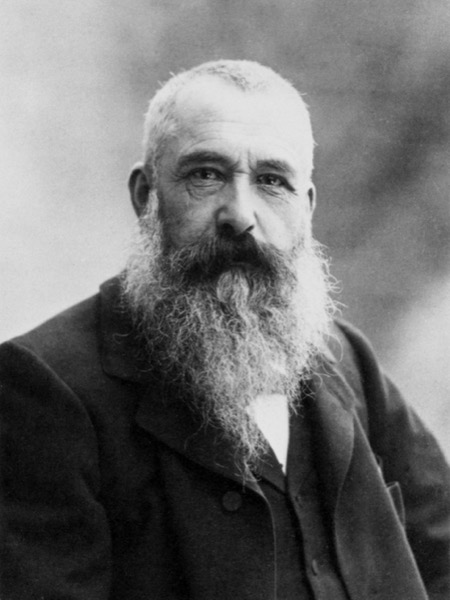
Claude Monet (1840–1926) was a founding figure of French Impressionism and the central painter of its theory: that the painting's subject is light's behavior on form, not the form itself. He worked primarily in landscape — gardens, water, urban scenes — and developed the practice of painting the same subject repeatedly across different lights, weather conditions, and times of day. His technical signature is broken color (small adjacent strokes of varied color that mix optically in the viewer's eye) and an extreme sensitivity to atmospheric and temporal change. His late work (the Water Lilies series, 1899–1926) approaches abstraction while remaining grounded in observation; the work becomes more about the act of seeing than the seen subject.
Monet exemplifies three principles: broken color, atmospheric color, and the discipline of the series. His broken color is the most teachable. Rather than mixing colors thoroughly on the palette and applying a single color to each passage, Monet places small adjacent strokes of related but distinct colors next to each other on the canvas. From a distance, the eye mixes them optically — producing a vibrating color quality that fully mixed paint cannot achieve. A "green" tree in a Monet might be made of touches of warm green, cool green, yellow, blue-green, and dabs of complementary red placed precisely to enliven the mass. Painters who learn broken color from Monet learn to think of color application as a series of decisions rather than as filling in shapes. His atmospheric color is the second principle. Monet was acutely sensitive to how light and air affect color. The same subject — a haystack, a cathedral facade, a row of poplars — looks different in morning light, midday, evening, in fog, in snow. His series paintings (Haystacks, Rouen Cathedral, the London Parliament series) are the systematic exploration of this principle. Painters studying Monet learn that color is not a property of objects but a property of the moment of observation, and that atmospheric conditions are the painter's primary subject in landscape work. His discipline of the series is the third principle, and arguably the deepest. Painting the same subject thirty or forty times across different conditions teaches the painter to see what changes and what stays the same. The structure of the haystack doesn't change; the color of the light hitting it does. The cathedral doesn't move; the atmosphere around it transforms. The painter learns to see through the local color of objects to the optical color produced by the light. This is the perceptual discipline that Cézanne, Matisse, and the entire modernist tradition would build on. Monet's late work — the Water Lilies, painted at his garden in Giverny across the last decades of his life — is some of the most extraordinary painting of the late 19th and early 20th centuries. The work becomes less and less concerned with the literal subject (the pond, the lilies, the willows) and more concerned with the visual experience itself. Some of the late panels approach pure color and atmosphere with only suggestions of form. Painters studying late Monet are studying the boundary between observation and abstraction — a boundary that the Color Field painters and Abstract Expressionists would explore further. The accessible Monet lessons are broken color and atmospheric color, which can be practiced at any scale. The harder Monet lesson is the series discipline, which requires committing to the same subject across many works rather than chasing variety.
- Impression, Sunrise (1872) — the painting that named the movement; broken color; atmospheric handling. - Haystacks series (1890–91) — the systematic series; same subject across light conditions. - Rouen Cathedral series (1892–94) — urban subject; series painting at its most rigorous. - The Water Lilies series (1899–1926) — late masterwork; abstraction emerging from observation. - The Houses of Parliament series (1900–1905) — London fog; atmospheric color at its most pronounced. - The Japanese Bridge (multiple, c. 1899–1924) — the garden subject; pre-abstraction late work.
The most useful Monet copy is a small section of one of the series paintings — a corner of a haystack, a section of the cathedral facade. Focus on the broken color: don't mix a single green for the grass, but place adjacent touches of multiple greens and complementary notes. Look for the way Monet introduces small complementary colors (a touch of red in green, a touch of blue in orange) to vibrate the mass. A second exercise is to paint your own series: the same subject at three different times of day or three different weather conditions. Note what changes and what stays the same. This is closer to the actual Monet lesson than copying a single work. A third exercise is to study a late Water Lilies panel as a pure color study, ignoring representational content. Match the color relationships rather than the depicted forms.
- Producing "Impressionist" surfaces (loose broken strokes) without the underlying color observation. - Treating broken color as a style rather than as a perceptual technique. - Studying single Monet paintings rather than series; the series discipline is half the lesson. - Ignoring the value structure: Monet's paintings work in black and white as well as in color, but the color reads first and students miss the underlying structure. - Working without atmospheric subject matter: Monet's lessons are most accessible in landscape and outdoor light; applying broken color to studio still life is a different problem. - Treating the late work as different from the early; the principles are continuous, just pushed further.
Monet is the founder figure of Impressionism with Renoir, Pissarro, Sisley, and Degas (the last with reservations about the movement). He was directly influenced by Boudin (the plein air master) and by Turner (whose late atmospheric work prefigures Impressionist atmospheric handling). After Monet, his influence runs through Cézanne (who reacted against him toward structure), through Matisse and the Fauves (who pushed his color further), and through the Color Field painters and Abstract Expressionists (who continued the line into pure color). The Giverny garden is itself part of his legacy — the painter constructed the subject he painted.
Atmospheric Perspective
How distance affects value, color, chroma, and edge. The visual signature of receding air — central to landscape, and relevant anywhere depth matters.
Color
The properties of hue, chroma, and temperature, plus the relationships between them — the second most powerful tool in painting after value, and the trickiest of the foundational principles to teach.
Light
How light reveals form. The form principle — light, halftone, core shadow, reflected light, cast shadow — is the bridge between drawing and convincing three-dimensionality.
↳ image rights status: public domain