Rembrandt van Rijn.
Dutch master of light, shadow, and psychological depth — the painter of soft and lost edges, where forms emerge from and dissolve into darkness.
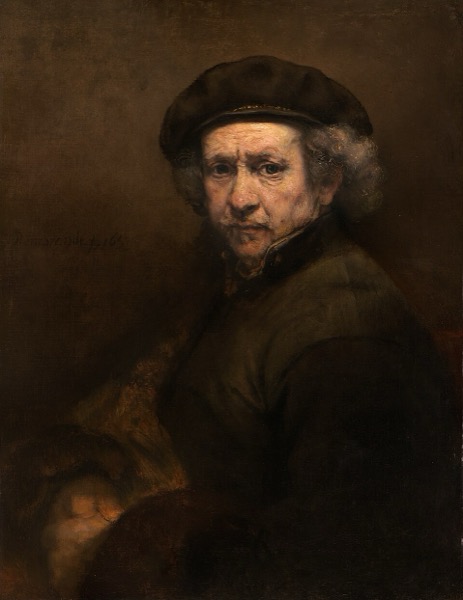
Rembrandt van Rijn (1606–1669) was a Dutch painter, printmaker, and draftsman whose career spans the Dutch Golden Age. He worked across history painting, portraiture (both individual and group), religious narrative, and self-portrait — the last across his entire adult life, producing a record of psychological aging unmatched in painting history. His technical signature is the management of value and edge: shadows that hold together as coherent masses with internal variation, lit forms that emerge from darkness through subtle transitions, and a paint surface that ranges from thin transparent glazes in shadow to thick impasto in highlights. His late work shows a kind of paint handling that anticipates the painterly tradition centuries before it would arrive elsewhere.
Rembrandt is the supreme exemplar of low-key value painting and of soft-and-lost edge handling. He is also one of the deepest psychological portraitists in Western art, but the psychological depth rests on the technical foundation: he can describe a face's complexity because he can manage the form transitions and the value relationships that make the face read as alive. His low-key value handling is the first lesson. A typical Rembrandt portrait places most of the painting in the shadow end of the value scale, with the light passages — a forehead, a hand, a piece of jewelry — emerging as small jewel-like areas of higher value. The shadow itself is never a uniform black; it holds together as a coherent mass but contains internal variation in temperature, in chroma, in subtle value shifts. This is the discipline of shadow integration that painters now refer to as the "Rembrandt shadow." It is the opposite of crushed shadow, where the painter has flattened all the dark values into uninformed black. His soft-and-lost edge handling is the second lesson. Rembrandt rarely lets a hard edge sit anywhere except at the focal point of the painting — usually a face, sometimes a hand. Everywhere else, edges are soft, lost, or partial. A shoulder dissolves into darkness; a sleeve fades into the surrounding shadow; a contour appears, disappears, and reappears. This edge handling integrates the figure with the painting's atmosphere and pulls the viewer's attention to the focal point with absolute precision. The Rembrandt light source is almost always single, directional, and warm — typically streaming from a window or implied as if from one. The shadow side is cool by contrast, and the reflected light in the shadow lifts the form just enough to keep it from becoming a black hole. This light logic is the most reliable formula in representational portraiture, and Rembrandt did not invent it but did refine it into its supreme expression. The self-portrait series across his career is its own course in technical and psychological development. Early self-portraits show a young man experimenting with expression, light, and surface — almost theatrical in some cases. By middle career, the self-portraits become more controlled and more refined. The late self-portraits (1660s) show a face aged by failure, financial trouble, and grief; the paint application is the loosest of his career, the surface roughest, the gaze most direct. Studying Rembrandt's self-portraits in sequence is a meditation on what it means for a painter to know themselves. Rembrandt's paint handling deserves a note. In his early career, the paint is more refined and modeled. By his late career, the impasto is thick — sometimes scraped, sometimes layered with palette knife, often built up to almost sculptural relief in the lit passages of a face. Light, in his late work, sits physically on the canvas. The shadows, by contrast, are often thinly painted, sometimes nearly translucent. The physical paint matches the value structure: thick where the light hits, thin where the shadow lives. This is paint quality as a load-bearing decision, not as a stylistic affectation. What Rembrandt does not exemplify as strongly is color: his palette is famously narrow, dominated by earth tones, blacks, and warm flesh notes. Painters studying him will learn value, edge, light, and surface, but should turn to Titian, Sorolla, or Monet for color education.
- Self-Portrait with Two Circles (c. 1665–69) — late self-portrait; supreme example of his mature handling. - The Night Watch (1642) — group portrait; light and composition; the painting that demonstrates the difference between Rembrandt and his contemporaries. - Bathsheba at Her Bath (1654) — figure painting; light modeling the form; the psychological treatment. - The Jewish Bride (c. 1665–69) — late work; tenderness and paint handling. - Aristotle with a Bust of Homer (1653) — psychological portrait; light handling on the chain and the hand. - The Anatomy Lesson of Dr. Tulp (1632) — group portrait; the early Rembrandt at his most coherent and rigorous.
The most useful Rembrandt copy for a student is a single face from a portrait — copying it at sight-size with the same value structure he used. Focus first on getting the shadow shape correct as a single value mass, then placing the lit passages as small jewel-like areas within that mass. The temptation is to render the face in full color; resist it. Rembrandt's color is so narrow that the value structure can be studied almost as a tonal exercise. A second useful copy is studying the brushwork in a single passage — typically a hand or a piece of jewelry — at high magnification. Pay attention to the paint thickness in the lights versus the thinness in the shadows. Note where the paint sits proud of the surface and where it sinks into it. A third useful exercise is to attempt your own self-portrait in the Rembrandt manner: warm directional light, cool reflected light in the shadows, focal point on the face, everything else dissolving into the surrounding atmosphere. Most students will struggle with the value structure; that's the diagnostic, and it is also the lesson.
- Crushing the shadows: treating Rembrandt's shadows as flat black when they are in fact coherent masses with internal variation. - Hard edges where Rembrandt would have soft or lost edges. - Over-rendering the shadow side: trying to describe everything in the shadow when Rembrandt would have left it ambiguous. - Imitating the late looseness without the underlying value discipline. - Studying his color: it's narrow, and other painters teach color better. - Treating self-portraits as biographical rather than as technical exercises. - Forgetting that Rembrandt's paintings get the way they look partly through age, varnish, and time; some of the warm depth is patination, not original paint.
Rembrandt stands at the center of the Dutch Golden Age, contemporary with Frans Hals (a very different painter — alla prima, high-key) and Vermeer (a generation younger, with very different sensibilities about light). He drew on the dramatic chiaroscuro tradition that came from Caravaggio's Italian followers, but Dutch Rembrandt is quieter and more domestic than Italian Caravaggio. After Rembrandt's death, his influence runs through Manet (who admired his paint handling), through 19th-century European realism, into Sargent, and into the 20th-century revival of painterly figure traditions. His self-portraits in particular have become the standing reference for psychological portraiture in Western painting.
Brushwork
The application of paint as a visual element — the painter's handwriting. Mark variety, paint quality, and the freshness of the surface.
Drawing
The foundation skill of accurate observation rendered in line and shape — the structural framework that underlies every other principle. Without sound drawing, no amount of color or brushwork can rescue a painting.
Edges
The quality of the boundary between two shapes — hard, soft, lost, or found. Edge variety directs the eye and integrates form with ground. Edge control is what separates competent painting from masterful painting.
Light
How light reveals form. The form principle — light, halftone, core shadow, reflected light, cast shadow — is the bridge between drawing and convincing three-dimensionality.
Value
The lightness or darkness of tones, independent of color — the structural backbone of any painting that reads at a distance. Often called the single most important principle in painting.
↳ image rights status: public domain