John Singer Sargent.
American painter of bravura brushwork — the modern master of edge variety and alla prima decision, working in a portrait tradition refined to its sharpest economy.
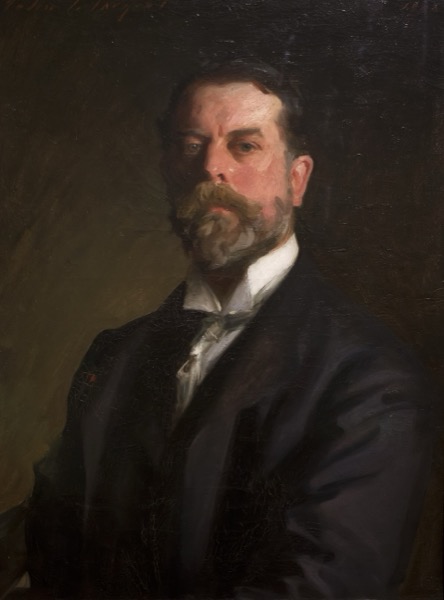
John Singer Sargent (1856–1925) was an American expatriate painter who worked principally in portraits, with secondary work in landscape watercolor (often regarded as some of his most personal work) and large-scale public murals. His portraits were the prestige commissions of late-19th and early-20th-century Europe and America. His technical signature is the placement of mark and edge: the seemingly effortless single stroke that describes a hand, a piece of lace, a gold chain — each placed with such precision that the apparent virtuosity reads as economy rather than display. Sargent worked alla prima primarily, with paintings often completed in extended single sessions, and the freshness of decisive placement is what gives the work its alive quality.
Sargent exemplifies four overlapping principles: bravura brushwork, edge variety, alla prima freshness, and economy of statement. His bravura brushwork is what most people see first. Sargent's mark is large, decisive, and apparently effortless — a single sweeping stroke can describe a silk sleeve; a few quick touches can describe a hand. The marks vary in size, direction, pressure, and saturation to match the form they describe. There is no uniform stroke, no mechanical repetition. The brushwork itself becomes part of the painting's life, not as ornament but as the visible record of decisive observation. The trap with bravura brushwork is the assumption that it is the goal of painting. Sargent's marks are confident because they record observations made before the brush touched the canvas. The painter who tries to produce Sargent-style marks without the underlying drawing, value, and color work will produce showy hollow paintings — and Sargent himself was clear-eyed about the difference. He once said that a portrait was "a likeness in which there is something wrong about the mouth," indicating his suspicion of the celebrity-portrait market his own success had created. His edge variety is the second principle, and arguably the deeper one. A typical Sargent portrait moves through hard, soft, lost, and found edges in the space of a single figure. The lit cheekbone is sharp; the shadow side of the face is softer; the dark dress dissolves into the dark background as a lost edge; the gold chain re-emerges as a found edge that draws the eye back to the face. This edge variety is the structural reason Sargent's portraits feel inhabited rather than pasted-onto-canvas. Painters who study Sargent for the brushwork without studying him for the edges miss the lesson that makes the brushwork possible. His alla prima freshness is the third principle. Most Sargent portraits were painted in extended sessions over a few weeks, with the painting built up rapidly during sittings rather than refined endlessly afterward. The paint sits cleanly on the canvas; passages are placed decisively and left alone. Reworked passages, where they exist, read as such — the freshness of decisive placement is preserved by Sargent's discipline of moving on rather than fighting a stroke. His economy of statement is the fourth principle, and the hardest to teach. Sargent describes a hand in three strokes because he knows what a hand does in this lighting at this angle; he does not need to render every finger. He describes lace in twelve marks because he has observed how lace catches the light and how few marks the eye requires to read "lace." The painter who has put in the observation can be economical; the painter who hasn't will fuss. The lesson of Sargent is that economy is the reward of attention. Sargent's late watercolors — landscapes and figure studies from Venice, the Mediterranean, the Alps — are some of the most technically free work in late-19th century painting. They reward study as much as the portraits do, and they show Sargent at his most personal, away from the demands of commissioned portraiture. What Sargent does not exemplify as strongly: deep psychological portraiture (his subjects often feel a bit distant, by design), composition as design statement (his portraits are usually conventional), color as a primary subject (his palette is refined but rarely the lesson).
- Madame X (1884) — the painting that made his reputation in Paris and nearly destroyed it through scandal; edge handling, silhouette, the off-the-shoulder dress. - Carnation, Lily, Lily, Rose (1885–86) — outdoor figure painting; lantern light; the late-19th-century painting equivalent of plein air figure. - The Daughters of Edward Darley Boit (1882) — group portrait; composition; the dark background and the placement of figures. - Lady Agnew of Lochnaw (1892) — portrait elegance; the diagonal pose; the relaxed figure. - El Jaleo (1882) — figure in motion; Spanish subject; light handling. - Venetian watercolor series (c. 1900–1913) — the late personal work; fluid watercolor mastery. - Gassed (1919) — public mural; large-scale figure composition; later darker tone.
The best Sargent copy is a single passage from a portrait — typically a hand, a face, or a piece of fabric. Copy at sight-size, paying careful attention to mark variety. Try to use the same number of strokes Sargent used; resist the urge to add more. A second exercise is to do a Sargent-style alla prima portrait of your own subject — fast, decisive, in extended sittings rather than refined over time. This will teach the discipline of decisive placement and the cost of indecision in paint. A third exercise is to study the late watercolors. Try to match the wetness, the speed, the economy. The watercolors are often where the technical lesson of Sargent is most concentrated, because watercolor punishes indecision more harshly than oil. The biggest pitfall in studying Sargent is mistaking the surface look for the underlying skill. The bravura is the visible top layer of years of disciplined drawing, value, and observation. A student who has not done that underlying work and tries to imitate the bravura will produce hollow paintings. A student who has done the underlying work and then studies Sargent will find the economy liberating.
- Imitation virtuosity: producing showy strokes without the observation behind them. - Studying him for surface look only and missing the edge variety, which is the deeper lesson. - Focusing only on the portraits and missing the watercolors, which often show the technique in clearer form. - Treating his economy as casualness rather than as the discipline of decision. - Comparing him to Velázquez and concluding he is a lesser painter; they are different painters answering different questions. - Overlooking his weaknesses — psychological depth, ambitious composition — and treating him as universally exemplary when he is specifically exemplary.
Sargent was the leading portrait painter of his era, working in a tradition that runs from Velázquez through Manet to Sargent and into 20th-century painterly portraiture. He was trained in Paris under Carolus-Duran, who emphasized direct alla prima painting over the academic preparatory method. Sargent influenced and was influenced by the American Impressionists (Childe Hassam, William Merritt Chase) and the Boston School. His direct technical influence runs into 20th-century portrait painting and beyond — most painterly portraitists of the last century have, in some sense, learned from Sargent.
Alla Prima
Wet-into-wet painting brought to completion in one session — the discipline of decisive marks placed once and left alone. Also called direct painting or premier coup.
Brushwork
The application of paint as a visual element — the painter's handwriting. Mark variety, paint quality, and the freshness of the surface.
Drawing
The foundation skill of accurate observation rendered in line and shape — the structural framework that underlies every other principle. Without sound drawing, no amount of color or brushwork can rescue a painting.
Edges
The quality of the boundary between two shapes — hard, soft, lost, or found. Edge variety directs the eye and integrates form with ground. Edge control is what separates competent painting from masterful painting.
Simplification
The skill of reducing visual information to its essential design — knowing what to leave out is often more important than knowing what to put in.
↳ image rights status: public domain