Joaquín Sorolla.
Spanish master of outdoor light — the supreme exemplar of warm-light-cool-shadow color logic, working in plein air figure painting at full scale and at speed.
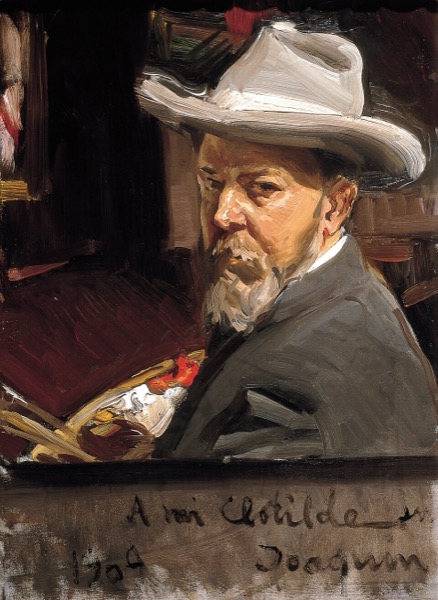
Joaquín Sorolla y Bastida (1863–1923) was a Spanish painter from Valencia who became one of the most successful painters in Europe and America at the turn of the 20th century. He worked extensively in plein air, often at large scale — paintings of fishermen, children at the beach, his own family in the garden — executed with bravura speed in the strong Mediterranean sun. His technical signature is the handling of outdoor light and its color logic: warm sunlight producing cool shadows, the warm reflected light from sand or stone bouncing into the figures, and a confident decisive paint application that captures the moment of optical observation without fussing. His scale (some paintings are wall-sized) is part of the achievement; he painted big alla prima, outdoors, with no second chance to fix what didn't work.
Sorolla exemplifies three principles working in concert: warm-light-cool-shadow color logic, plein air decisive brushwork, and the figure in outdoor light. His warm-light-cool-shadow handling is the universal lesson. Painting in the Mediterranean sun, Sorolla observed that the warm direct light produces shadows that are not just darker but cooler — bluish-purple on skin, gray-green on cloth, cool gray on the sand. This temperature inversion is the rule for direct sunlight, and Sorolla applies it consistently across his work. The result is that his figures read as actually being in sunlight rather than as figures painted under studio light and re-labeled. Painters who learn this rule from Sorolla and apply it to their own outdoor or sun-lit work will see immediate gains in convincing light handling. His plein air decisive brushwork is the second principle. Sorolla painted fast — necessarily, because the Mediterranean sun moves quickly and his motifs (waves, wet sand, children moving in light) would not hold still. The paint goes down once and stays. Sorolla's economy is different from Sargent's: where Sargent is a portraitist working in a controlled studio with extended sittings, Sorolla is a plein air painter racing the light, with figures sometimes in motion. The marks are larger, the touch more rough, the surface less refined — but the freshness is the same kind of decisive placement that Sargent's portraits show. His outdoor figure handling is the third principle. Most figure painting through Western art history is studio work; the figure is posed under controlled light. Sorolla painted figures in actual outdoor light — at the beach, in the garden, by the sea — which presents a different set of problems. The skin tones are different in sun than in studio light. The shadow side of the figure is lit by reflected light from the surroundings — bright reflections from sand, from water, from rocks. The contour edges of the figure shimmer in the air rather than sitting crisply against a backdrop. Sorolla solved all of these problems, repeatedly, at large scale. The work is the standing reference for outdoor figure painting. The Sorolla challenge for student painters is the speed and the scale. His paintings are often physically large — life-size or bigger — and were executed in single sessions. Most student painters cannot work at that scale or that speed without losing structural integrity. The accessible Sorolla lesson is the color logic, which can be studied at any scale: warm light, cool shadow, decisive temperature handling. The advanced Sorolla lesson is the speed and confidence, which requires years of preparation.
- Niños en la Playa / Children on the Beach (1910) — figures in wet sand; warm-light-cool-shadow at its most explicit. - La Hora del Baño / The Bathing Hour (1909) — Mediterranean color handling at full scale. - Cosiendo la Vela / Sewing the Sail (1896) — earlier work; interior light; transitional between studio and plein air. - Paseo a Orillas del Mar / Walking on the Beach (1909) — wife and daughter in the wind; movement and atmosphere. - Las Tres Hermanas / The Three Sisters on the Beach (1908) — group figure composition outdoors. - Vision of Spain murals (1911–19) — large-scale ethnographic Spanish series; the late masterwork at the Hispanic Society in New York.
The most useful Sorolla copy is a small section of figure in outdoor light — typically a section of skin in sun and shadow, or a piece of fabric in wind. Focus on the color temperature: where is the warm, where is the cool, and does the relationship hold? Most students will under-cool the shadows; correct that aggressively. A second exercise is to attempt your own outdoor study under direct sunlight — a figure if possible, or just a still life on a sunny tabletop — and apply the warm-light-cool-shadow rule deliberately. Photograph in black and white afterward to check whether the value structure also reads. A third exercise is to study his late ethnographic series — the wall-sized works in the Hispanic Society in New York — as compositional and tonal studies. Even at smaller reproduction scale, the handling of figure-in-environment is instructive.
- Studying the surface look (the bold marks) without studying the color logic (the warm-cool play). - Trying to work at his scale before having developed the underlying speed and confidence. - Treating him as a "Spanish Impressionist" — he is more accurately a plein air realist with Impressionist sympathies. - Ignoring the studio work; his early studio paintings show how the outdoor confidence was developed. - Studying him for color without noting that the values are also strong; in black and white, his paintings still hold up. - Treating Mediterranean light as exotic and assuming his lessons do not apply to other latitudes. The color logic is universal; only the saturation of effect differs.
Sorolla worked at the intersection of Spanish realism, Impressionism, and plein air. He was admired by John Singer Sargent (the two were friendly and mutually influential), and his major American champion was Archer Huntington of the Hispanic Society, who commissioned the Vision of Spain murals. He stands alongside the American Impressionists (Hassam, Twachtman) and the Russian outdoor realists (Levitan, Serov) as a turn-of-the-century outdoor figure painter. His direct influence runs into 20th-century plein air, especially the California Plein Air movement (Edgar Payne, Guy Rose), and into contemporary representational outdoor painting.
Atmospheric Perspective
How distance affects value, color, chroma, and edge. The visual signature of receding air — central to landscape, and relevant anywhere depth matters.
Brushwork
The application of paint as a visual element — the painter's handwriting. Mark variety, paint quality, and the freshness of the surface.
Color
The properties of hue, chroma, and temperature, plus the relationships between them — the second most powerful tool in painting after value, and the trickiest of the foundational principles to teach.
Light
How light reveals form. The form principle — light, halftone, core shadow, reflected light, cast shadow — is the bridge between drawing and convincing three-dimensionality.
↳ image rights status: public domain