Diego Velázquez.
The Spanish court painter whose technical economy and edge control made him the painter's painter — admired by Manet, Sargent, and every realist tradition since.
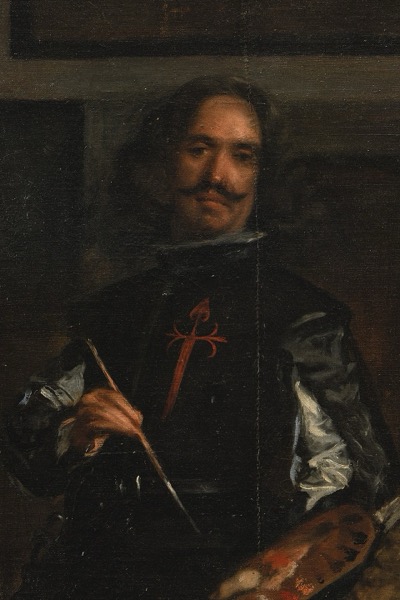
Diego Velázquez (1599–1660) is widely considered one of the most influential painters in Western art history — admired specifically by other painters for technical qualities that are difficult to describe and difficult to copy. He worked primarily as court painter to Philip IV of Spain, producing portraits of the royal family, courtiers, the court dwarfs, religious figures, and mythological scenes. His paintings are characterized by an extraordinary economy of means: surfaces that appear photographically real from a distance but resolve into loose, abbreviated brushwork up close. This duality — apparent finish at viewing distance, apparent freedom at inspection distance — is the technical signature that has made Velázquez a perennial study subject for representational painters.
Velázquez is the supreme exemplar of three closely related principles: edge control, brushwork economy, and figure-ground integration. Each is observable across his work and each rewards careful study. His edge control is the first thing painters notice. A typical Velázquez portrait moves through the full range of edge types within a single figure: a sharp hard edge at the lit cheekbone or the bridge of the nose, a soft transition into the shadow side of the face, a lost edge where the dark clothing merges with the dark background, and a found edge as the contour of the shoulder re-emerges. This variety is what allows his figures to live in space rather than sit pasted onto a backdrop. Painters who study Velázquez are studying edge handling above all else. His brushwork economy is the second. Up close, Velázquez's paintings are remarkably abbreviated: a courtier's lace collar might be twelve quick marks, a hand might be three strokes, an embroidered sleeve might be a constellation of touches that read as ornament only because the painter has placed them with absolute precision. There is no fussing, no fighting, no over-rendering. Each stroke describes what it needs to describe and then stops. This is the economy that Manet, Sargent, and later realists came to revere — and that none of them quite achieved. The integration of figure and ground is the third. Velázquez never paints a figure as a separate cut-out laid on a backdrop; the figure and the air around it belong to the same picture. He achieves this through the edge variety described above and through a kind of color-temperature consistency: the warm tones of the flesh have warm counterparts in the background; the cool shadows are echoed in the surrounding air. Velázquez was also a master of psychological observation. His portraits of King Philip IV across decades show a man aging from confident young king to weary, slightly resigned figure. His portraits of the court dwarfs — Sebastián de Morra, Don Diego de Acedo — refuse to render them as comic figures and instead grant each one a fully realized human presence. His Las Meninas (1656) is the most famous example: a painting that contains the artist himself, the royal family, the dwarfs, the dog, the mirror reflection of the king and queen, and an open question about what the painting actually depicts. Centuries of painters have studied this work and still cannot fully account for its construction. The Velázquez touch developed across his career. Early works are more thoroughly modeled and more detail-laden. By the late career (the Rokeby Venus, Las Meninas), the touch has become impossibly free — paint applied with almost casual decisiveness but producing forms of complete authority. The trajectory is itself a lesson: technical mastery in painting tends toward less, not more. The Velázquez problem for student painters is that the surface looseness is impossible to imitate without the underlying observation. Painters who try to produce Velázquez-style loose brushwork without the underlying drawing, value structure, and color logic produce paintings that look sloppy rather than free. The looseness is the visible top layer of years of disciplined seeing.
- Las Meninas (1656) — perhaps the most studied painting in Western art; a technical and conceptual masterpiece. - The Surrender of Breda (1634–35) — figure composition and atmospheric handling. - Portrait of Pope Innocent X (1650) — psychological portraiture; flesh tones; the red palette. - The Rokeby Venus (c. 1647–51) — the figure in the most economic Velázquez touch. - Portrait of Juan de Pareja (1650) — flesh tones, edge variety, restraint; the painter's slave-then-collaborator. - Sebastián de Morra (c. 1645) — a small portrait of one of the court dwarfs; psychological observation; the human dignity of the subject.
Studying Velázquez through master copy works best with specific passages rather than full paintings. The hands and faces from his portraits are extremely instructive: copying them at sight-size forces the student to observe edge variety closely. The clothing — especially the lace, the brocades, the silks — teaches abbreviated brushwork: how few marks can describe a complex texture. The shadow-side passages teach lost edges and value-mass integration. The trap to avoid is copying the surface look without copying the underlying observation. Velázquez did not paint loose; he painted decisively. The economy of his marks comes from knowing exactly what the form is doing before the brush touches the canvas. A student copy that tries to produce Velázquez looseness without first establishing the drawing will produce a mess. The discipline is to draw the form rigorously, then commit to as few marks as possible. Velázquez works best as a study subject for intermediate-to-advanced painters. Beginners studying him will mostly absorb the wrong lessons (that paint can be applied casually). Painters who have already developed sound drawing, value, and color discipline can learn the most from his economy.
- Imitating the surface looseness without the underlying observation, producing sloppy paint rather than confident paint. - Copying just the brushwork and ignoring the edge variety, which is the real lesson. - Studying him primarily as a colorist (he isn't) rather than as an edge-and-value painter. - Treating Las Meninas as a system to be decoded rather than as a painting to be observed. - Copying full paintings before being able to copy individual passages well. - Ignoring his early career, which shows how the late freedom was earned through years of more deliberate work.
Velázquez stands at the center of the Spanish Golden Age, between the religious dramatic chiaroscuro of his Italian predecessors (Caravaggio's Spanish admirers, Zurbarán, Ribera) and the eventual Spanish romantic tradition that would lead to Goya. He spent two years in Italy studying Titian's late work — the lineage of painterly brushwork runs through that influence. He was directly studied by Manet (who saw his Pope Innocent X in Rome and re-engaged painterly tradition through it), by Sargent (who treated him as the supreme example of confident touch), and by every realist painter since the 19th century. The "painter's painter" phrase that gets attached to him reflects this: his technical qualities are most accessible to people who have already tried to do them themselves and failed.
Brushwork
The application of paint as a visual element — the painter's handwriting. Mark variety, paint quality, and the freshness of the surface.
Edges
The quality of the boundary between two shapes — hard, soft, lost, or found. Edge variety directs the eye and integrates form with ground. Edge control is what separates competent painting from masterful painting.
Light
How light reveals form. The form principle — light, halftone, core shadow, reflected light, cast shadow — is the bridge between drawing and convincing three-dimensionality.
Value
The lightness or darkness of tones, independent of color — the structural backbone of any painting that reads at a distance. Often called the single most important principle in painting.
↳ image rights status: public domain