Johannes Vermeer.
The Dutch master of window light and quiet interiors — paintings of mathematical compositional rigor where light reveals form with optical precision.
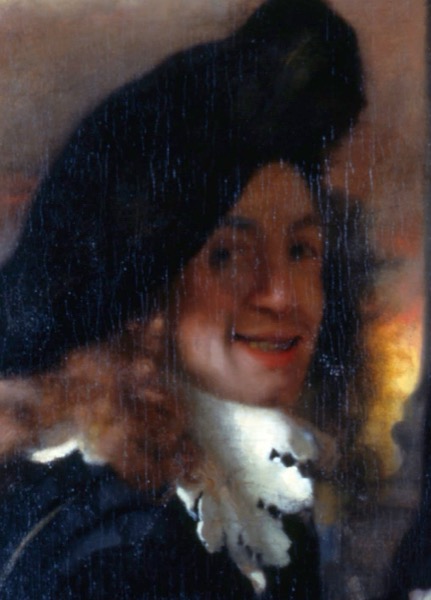
Johannes Vermeer (1632–1675) was a Dutch painter who worked primarily in Delft. Only about 35 paintings survive; the catalogue is small but the influence is enormous. His subjects are almost entirely domestic interiors — a woman reading a letter by a window, a maid pouring milk, a girl with a pearl earring — but the paintings are far from quaint. They are studies in optical precision, atmospheric light, mathematical perspective, and color temperature, executed with a technical control that has invited centuries of speculation about whether he used a camera obscura. The truth is probably that he did use optical aids alongside direct observation, but the paintings themselves are the answer to how he saw: every surface, every value, every edge has been considered.
Vermeer exemplifies four principles, all working together: window light, optical realism, compositional rigor, and color temperature. His window light is the most teachable. Almost every Vermeer painting is lit from a single window on the left side of the picture, with soft cool daylight filling the interior. The light falls on the figure, the table, the wall, the floor — each surface receiving the light at a different angle and reflecting it differently. The shadow side of every form is lifted by reflected light from the surrounding interior; nothing reads as a black hole. The light has a consistent direction across the entire painting, which gives the rooms their characteristic quiet coherence. Painters studying window light should study Vermeer first. His optical realism is the second principle. Vermeer paints what the eye actually sees, including effects that less attentive painters miss: the slight haze of distant detail, the highlights on small specular surfaces (a pearl, a glass, a metal pitcher), the way edges soften slightly even at short distances. The "Vermeer dot" — small points of color highlight on textured surfaces — is famous: the painter has observed how light hits the irregular surfaces of fabric, ceramic, or wood and recorded those small points without fully modeling them. This is observation as technical decision: the painter sees what is there, decides what to record, and leaves the rest to the viewer's eye. His compositional rigor is the third. Vermeer's rooms are constructed with mathematical precision — vanishing points, eye levels, scale relationships, all internally consistent. But the compositions are not mechanical. The Music Lesson, The Art of Painting, Woman Holding a Balance — each is a tightly designed image where the placement of every element answers the composition's larger question. The figures are placed not where they happen to be but where the painting needs them. The negative spaces between objects are designed as carefully as the objects themselves. Painters studying composition can learn from Vermeer how rigor and quiet can coexist. His color temperature handling is the fourth. Cool window light, warm interior shadows, slight warm reflections from the wooden floor or the figure's clothing — Vermeer's interiors are carefully temperature-balanced. The blues are famously his (often using ultramarine, an expensive pigment), but the blue passages are never alone — they sit next to warm yellow or red passages that play against them. The temperature contrast is what gives the paintings their characteristic luminosity. Painters who think only in hue will miss this; painters who learn to see in temperature first will recognize what Vermeer is doing. Vermeer is also unusual in that his small surviving body of work means painters can study almost the entire catalogue rather than picking and choosing. Each painting rewards extended attention.
- Girl with a Pearl Earring (c. 1665) — the universal Vermeer; flesh tones, soft edges, the pearl as small specular study. - The Milkmaid (c. 1660) — interior light handling; surface description; quiet narrative. - View of Delft (c. 1660–61) — landscape (rare for Vermeer); atmosphere; the white passage that Proust admired. - The Art of Painting (c. 1666–68) — composition; the painter at work; complex layered composition. - Woman Holding a Balance (c. 1664) — light; composition; symbolic content held within technical mastery. - The Music Lesson (c. 1662–65) — perspective; the composition built on its mathematical armature.
A useful Vermeer copy is a single passage of light hitting a surface — typically a section of wall, a window frame, or a tabletop. Focus on the temperature transitions within the lit and shadowed passages. Match the values precisely; Vermeer's value range is often compressed, and getting it right requires careful observation. A second useful exercise is to copy a Vermeer composition as a notan thumbnail — reducing it to three or four values and asking what makes the design work. Most students will discover that the composition is more rigorous than it first appears: every shape has a place, every space has been considered. A third exercise is to study the "Vermeer dot" technique: small points of color highlight on textured surfaces. Try it on your own still life — observe where the light catches the irregular surfaces of cloth, wood, or ceramic and record those points without modeling the underlying form.
- Treating Vermeer as merely quiet rather than rigorously composed. - Imitating the "Vermeer blue" without understanding the warm-cool temperature balance that makes it work. - Over-modeling: trying to render every surface fully when Vermeer suggests rather than describes. - Ignoring the composition: focusing on the figure and missing that the room itself is the picture. - Studying only from photographs: reproductions almost always lose the surface subtlety; in-person viewing is qualitatively different. - Treating him as a painter only of women in domestic interiors; View of Delft shows his range. - Getting distracted by the camera obscura debate at the expense of the painting itself.
Vermeer worked in Delft, peer to the Dutch Golden Age masters (Rembrandt, Hals, Pieter de Hooch), and largely unknown outside of Delft during his lifetime. His rediscovery in the 19th century made him retroactively central to the Western canon. He has influenced modern realists (Hopper acknowledged the debt), and the camera-obscura debate has made him a frequent subject in studies of art-and-science. His paintings show what is possible when a small body of work is brought to full technical resolution. The discipline of producing roughly one painting a year for fifteen years, each carried to optical and compositional refinement, is itself a model of patient practice.
Composition
The arrangement of shapes and the design of the picture plane — the structure on which everything else hangs. Successful composition leads the eye in, holds it at the focal point, and prevents it from escaping the frame.
Edges
The quality of the boundary between two shapes — hard, soft, lost, or found. Edge variety directs the eye and integrates form with ground. Edge control is what separates competent painting from masterful painting.
Light
How light reveals form. The form principle — light, halftone, core shadow, reflected light, cast shadow — is the bridge between drawing and convincing three-dimensionality.
Linear Perspective
The geometric system for representing three-dimensional space on a two-dimensional surface — the rules of receding lines and vanishing points.
↳ image rights status: public domain