James McNeill Whistler.
American expatriate painter of compressed tonal harmony — the supreme exemplar of simplification, restraint, and the painting as design rather than illustration.
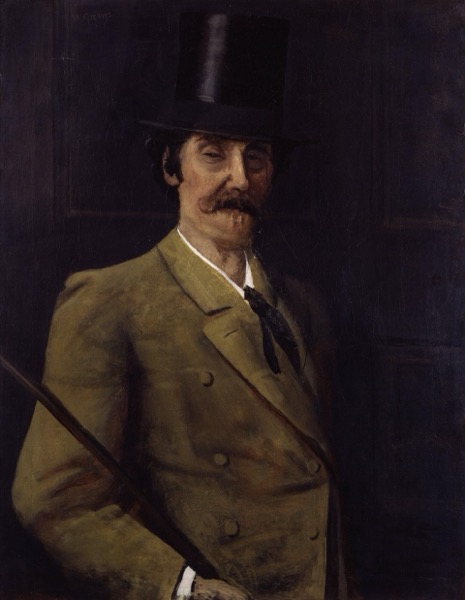
James McNeill Whistler (1834–1903) was an American painter who worked primarily in London and Paris. He developed a personal approach to painting often labeled Tonalism or Aestheticism — paintings of muted, compressed value range, often with a single warm or cool dominant temperature, organized as design rather than as narrative. His subjects were portraits (Arrangement in Grey and Black, the so-called "Whistler's Mother"), urban riverscapes (the Nocturnes of the Thames), and small genre interiors. His technical signature is value compression (the entire painting often within three or four close values), warm/cool dominant temperature harmony, edge subordination, and rigorous design economy. He wrote about painting as much as he painted, and his theoretical writings are part of his legacy.
Whistler exemplifies three principles: compressed tonal harmony, simplification, and the painting as design statement. His compressed tonal harmony is the most distinctive. A typical Whistler Nocturne (his term for the urban riverscape paintings) sits within a narrow band of close values — perhaps three or four steps on the value scale — with no extreme contrasts. The painting reads as a quiet tonal study where every value is held in close relationship to its neighbors. The Tonalist tradition that follows Whistler (Inness, Tryon, Dewing) builds on this compressed approach. The lesson for painters: full dynamic range is one option, not the only one. Whistler's compressed range produces a meditative, atmospheric quality that high-contrast painting cannot. His simplification is the second principle. A Whistler riverscape reduces a complex urban subject — bridges, boats, buildings, lights — to a small number of large shapes, with detail suggested rather than rendered. A figure is often a silhouette or near-silhouette. The supreme example is Arrangement in Grey and Black No. 1 (Whistler's Mother): a portrait reduced to a near-flat profile against a near-flat background, with minimal modeling and maximum design. Painters who study Whistler learn the discipline of editing — what to leave out is the lesson. His design statement is the third principle. Whistler titled his paintings as if they were musical compositions — "Nocturne in Blue and Silver," "Symphony in White," "Arrangement in Grey and Black" — emphasizing that the picture is a designed object operating on color and tonal harmony, not an illustration of a subject. The titles are programmatic: the painter is asking the viewer to see the painting as design rather than as representation. This stance prefigures the Aesthetic Movement, the emergence of "art for art's sake" as a stance, and the eventual move toward abstraction. Whistler's challenge as a study subject is that his discipline is restraint, and restraint is harder to teach than virtuosity. A student painter can mimic Sargent's bravura more easily than they can mimic Whistler's economy. The Whistler lesson is the negative one — what to leave out, what to suppress, what to avoid — which requires considerable underlying ability to be applied successfully. What Whistler does not exemplify well: full-range value painting, structural form modeling, color saturation, ambitious composition. His work is intentionally restrained; the restraint is the lesson. Painters studying full-range value should study Caravaggio or Rembrandt; painters studying saturated color should study Sorolla or the Impressionists; painters studying Whistler should be studying compression, harmony, and design economy.
- Arrangement in Grey and Black No. 1 (Whistler's Mother) (1871) — the famous portrait; design economy; tonal harmony. - Nocturne in Black and Gold: The Falling Rocket (1875) — the urban riverscape; the painting that led to the Whistler v. Ruskin trial. - Symphony in White, No. 1: The White Girl (1862) — figure painting; tonal study of white-on-white. - Nocturne: Blue and Gold — Old Battersea Bridge (c. 1872–75) — urban Nocturne; tonal compression. - Harmony in Pink and Grey: Portrait of Lady Meux (1881) — portrait elegance; tonal harmony. - The Peacock Room (1876–77) — interior design as painting; aestheticism applied to a room as a single artwork.
The most useful Whistler copy is a Nocturne. Match the value range exactly: identify the lightest light and the darkest dark in the painting, and copy within that compressed range. Most students will reflexively push the values further than Whistler did; resist that and stay within the original range. A second exercise is to paint your own subject in the Whistler manner: choose a subject (urban evening, interior, portrait) and deliberately compress the value range. Suppress the highest highlights and the deepest darks; work within three or four close values; let the picture read as tonal study rather than as illustration. A third exercise is to do a notan thumbnail of a Whistler painting, reducing it to three values. Note how decisively designed the light/dark pattern is, even in the most compressed pictures.
- Pushing the values further than Whistler did, breaking the tonal compression that is his lesson. - Treating his economy as casualness or as unfinished painting; the simplification is deliberate. - Studying him for color when his lesson is value (his color palette is famously narrow). - Ignoring his design rigor: the paintings look casually composed but are not. - Comparing him to high-contrast Baroque painters and concluding he is a lesser painter; they answer different questions. - Treating Whistler's Mother as sentimental portraiture rather than as a tonal-harmony study.
Whistler stands between American Realism (Eakins, Homer), British Aestheticism, and French Impressionism (he knew Manet and the circle). He is the founding figure of American Tonalism (Inness, Tryon, Dewing) and a forerunner of the Aesthetic Movement that runs through Oscar Wilde and into early modernism. His writings shaped the discourse around painting as art rather than illustration. The famous Whistler v. Ruskin trial (1878), in which Ruskin accused Whistler of "flinging a pot of paint in the public's face" with Falling Rocket, was a landmark in establishing the painter's right to be evaluated as artist rather than as illustrator. Whistler won the case but was awarded a single farthing in damages and was financially ruined by the legal costs — a painter's victory in principle and a person's defeat in practice.
Color
The properties of hue, chroma, and temperature, plus the relationships between them — the second most powerful tool in painting after value, and the trickiest of the foundational principles to teach.
Composition
The arrangement of shapes and the design of the picture plane — the structure on which everything else hangs. Successful composition leads the eye in, holds it at the focal point, and prevents it from escaping the frame.
Edges
The quality of the boundary between two shapes — hard, soft, lost, or found. Edge variety directs the eye and integrates form with ground. Edge control is what separates competent painting from masterful painting.
Simplification
The skill of reducing visual information to its essential design — knowing what to leave out is often more important than knowing what to put in.
Value
The lightness or darkness of tones, independent of color — the structural backbone of any painting that reads at a distance. Often called the single most important principle in painting.
↳ image rights status: public domain